The Certainty Paradox
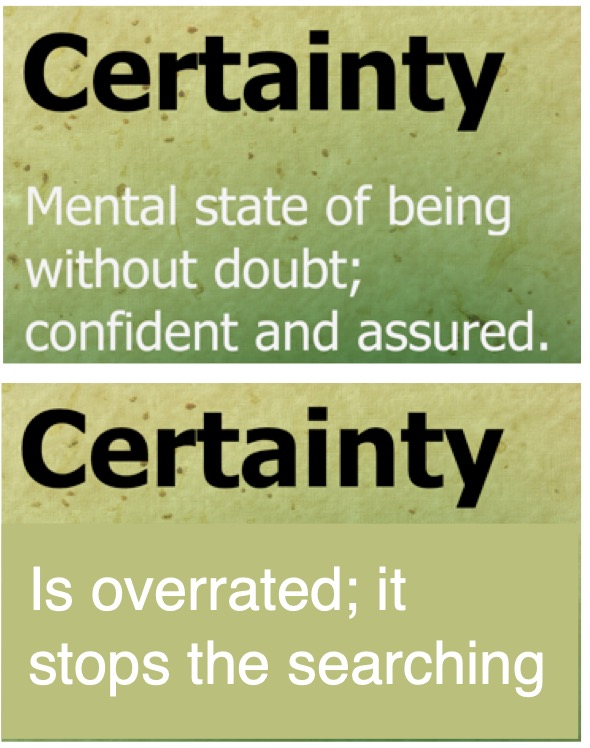
We all wish to be confident and assured, but does this really mean being without doubt, or does it mean understanding and accepting that there must always be doubt - but nevertheless to be confident enough in our flexibility and in our ability to handle what life will throw up? I think we are better asset managers for taking the second route.
The more doubts that we are able to process and think about before we make a decision, the less likely that we will be really wide of the mark in whatever decision we do make; also the more likely that if we do need to make changes, we will quickly recognise that fact and be flexible enough to do so.
SAM 381 applies this thinking to the determination of Asset Lives.
A Lust for Certainty
Some 25 years ago the Archbishop of York was being interviewed on the BBC. The
Interviewer said, ‘Your Grace, people have this urge for certainty, but you give only doubt.’ The Archbishop thought for a moment and then quietly said: ‘Have you ever considered that the lust for certainty might itself be a sin?’
This is an intriguing statement; many think it a virtue to be certain. Yet it may well be true that, in an essentially unknowable world, we commit the sin of arrogance, even hubris, to claim certainty. Yet politicians, in particular, believe they must be seen as leaders. Indeed, I recall one fellow saying that although he did not believe in the policies of Margaret Thatcher, he would still vote for her, since she seemed to be the only politician who knew where she was going.
Politicians, and many CEOs, want to know ‘will this work or won’t it?’ and do not take kindly to an answer of ‘It depends’. So how do we, as asset managers, take a more nuanced position? I had the advantage of working for a very bright politician as a Ministerial Advisor. Like others, he wanted an answer that enabled him to make a decision. But he was bright enough not to expect certainty.
I would say, “Minister, I think, on balance, the best course of action is X. However, there is a possibility that if you do this, you will experience problems with Y and if this happens, the best response is Z.” By anticipating problems and providing solutions to them, I was able to retain my integrity and provide action-worthy advice. It also meant I needed to monitor the outcomes, so my advice improved over time. This is not bad advice for Asset Managers, either.